
10 symbols · one click each
Wavy Dash
A wavy dash is a horizontal line that swings up and down instead of staying straight. The family includes the swung dash (⁓), the Japanese wave dash (〜), the wavy dash (〰) and the fullwidth tilde (~), plus mathematical tildes such as ∼ and ∽.
Copy any symbol
Click a tile to copy. Each symbol’s name links to its full codes and typing page in the table below.
Codes for wavy dashes & tildes
Every symbol in this category with its Unicode code point and a recommended HTML value. Click the glyph or any chip to copy it.
| Symbol | Name | Unicode | HTML |
|---|---|---|---|
| Swung DashGeneral Punctuation | |||
| Wave DashCJK Symbols and Punctuation | |||
| Wavy DashCJK Symbols and Punctuation | |||
| Fullwidth TildeHalfwidth and Fullwidth Forms | |||
| Tilde OperatorMathematical Operators | |||
| Reversed TildeMathematical Operators | |||
| Triple TildeMathematical Operators | |||
| Tilde with Ring AboveSupplemental Punctuation | |||
| Tilde with Dot AboveSupplemental Punctuation | |||
| Tilde with Dot BelowSupplemental Punctuation |
HTML values are named entities where a common one exists, otherwise decimal numeric references that work in any HTML document.
Using wavy dashes & tildes
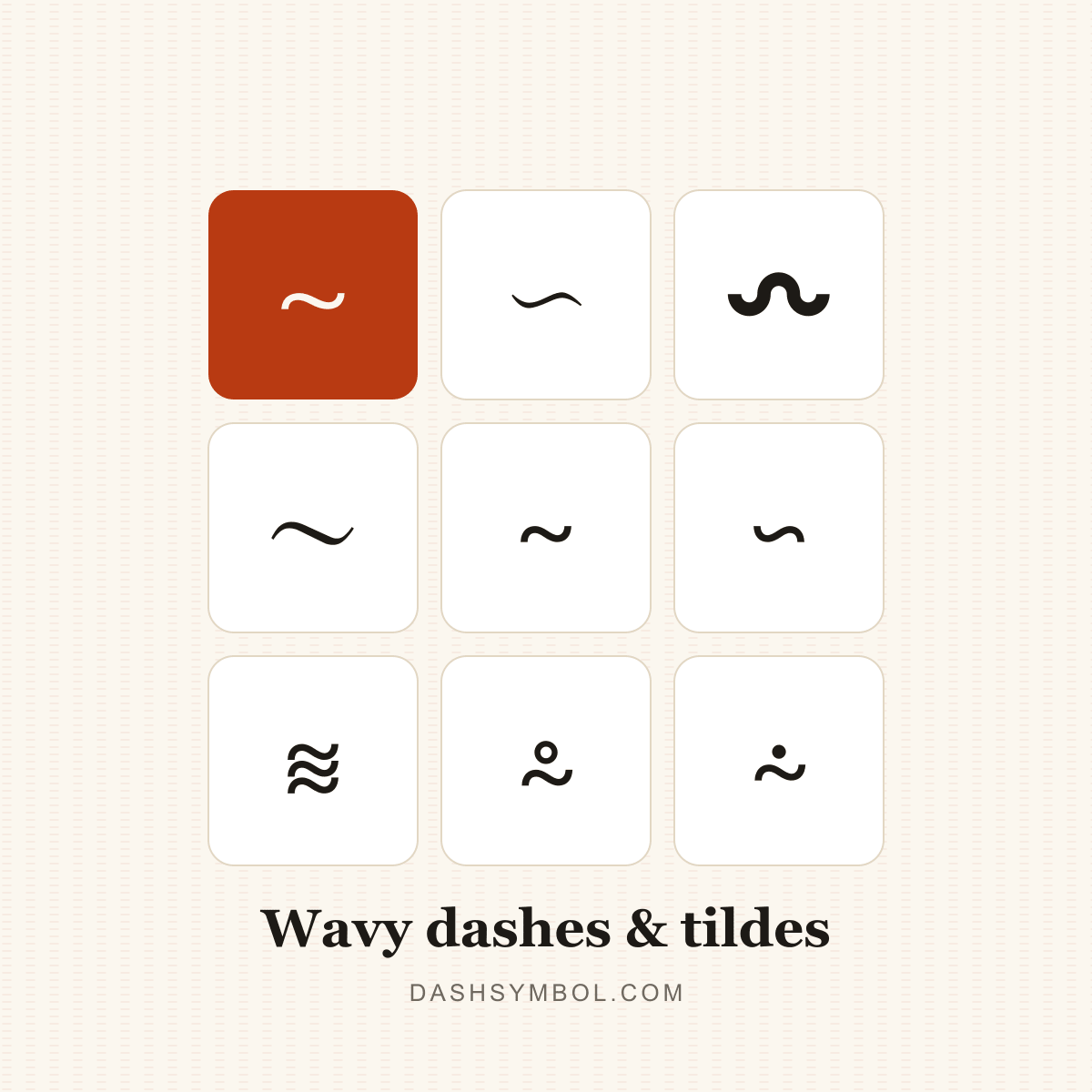
These marks are not interchangeable. In Japanese, 〜 marks ranges such as 1〜3; in dictionaries, ⁓ stands for the headword; in mathematics, ∼ is a relation, not decoration. The Supplemental Punctuation variants ⸛, ⸞ and ⸟ are rare punctuation marks.
The ASCII tilde (~, U+007E) is a separate character and sits higher on the line. If you need a wave in running text, choose the character that matches the language and purpose; if you need an English range, an en dash is usually the better choice.
- Click a tile to copy the symbol; the “Copied!” badge confirms it is on your clipboard.
- Open a symbol’s page for its Unicode name, HTML entity, CSS and JavaScript escapes, UTF-8 bytes and keyboard routes.
- Use the dash converter when you need to replace hyphens across a whole text.
- Use the dash line generator when you want a divider or a repeated line at an exact length.
Need the wider picture? Read the hyphen vs dash guide, the em dash vs en dash guide, or how to type a dash. For sentence-level patterns, see the em dash examples.
Related dash categories
Wavy dashes questions
What is a wavy dash?
A wavy dash is a horizontal line shaped like a wave or tilde. Unicode has several: the swung dash ⁓, the Japanese wave dash 〜, the wavy dash 〰 and the fullwidth tilde ~, plus mathematical tilde operators.
What is the difference between ~ and 〜?
The ASCII tilde (~, U+007E) is a keyboard character that sits high on the line. The wave dash (〜, U+301C) is a full-width Japanese punctuation mark used for ranges. They are different code points with different widths and uses.
What is a swung dash used for?
The swung dash (⁓, U+2053) is used in dictionaries and reference works to stand for the headword in examples, so the word does not have to be repeated. It can also serve as a general wave-shaped dash.
Is the tilde operator ∼ a minus sign?
No. ∼ (U+223C TILDE OPERATOR) is a mathematical relation, often read as “is similar to” or “is asymptotically equal to”, depending on the field. It is not a subtraction sign and is not a decorative dash.