
11 symbols · one click each
Hyphen Symbols
A hyphen is the short horizontal mark that joins the parts of a compound word or shows where a word may break at the end of a line. The everyday character is the hyphen-minus (-), which shares a key with the underscore; Unicode also gives the hyphen its own code point (‐), a non-breaking form (‑) and fullwidth and small forms for CJK text.
Copy any symbol
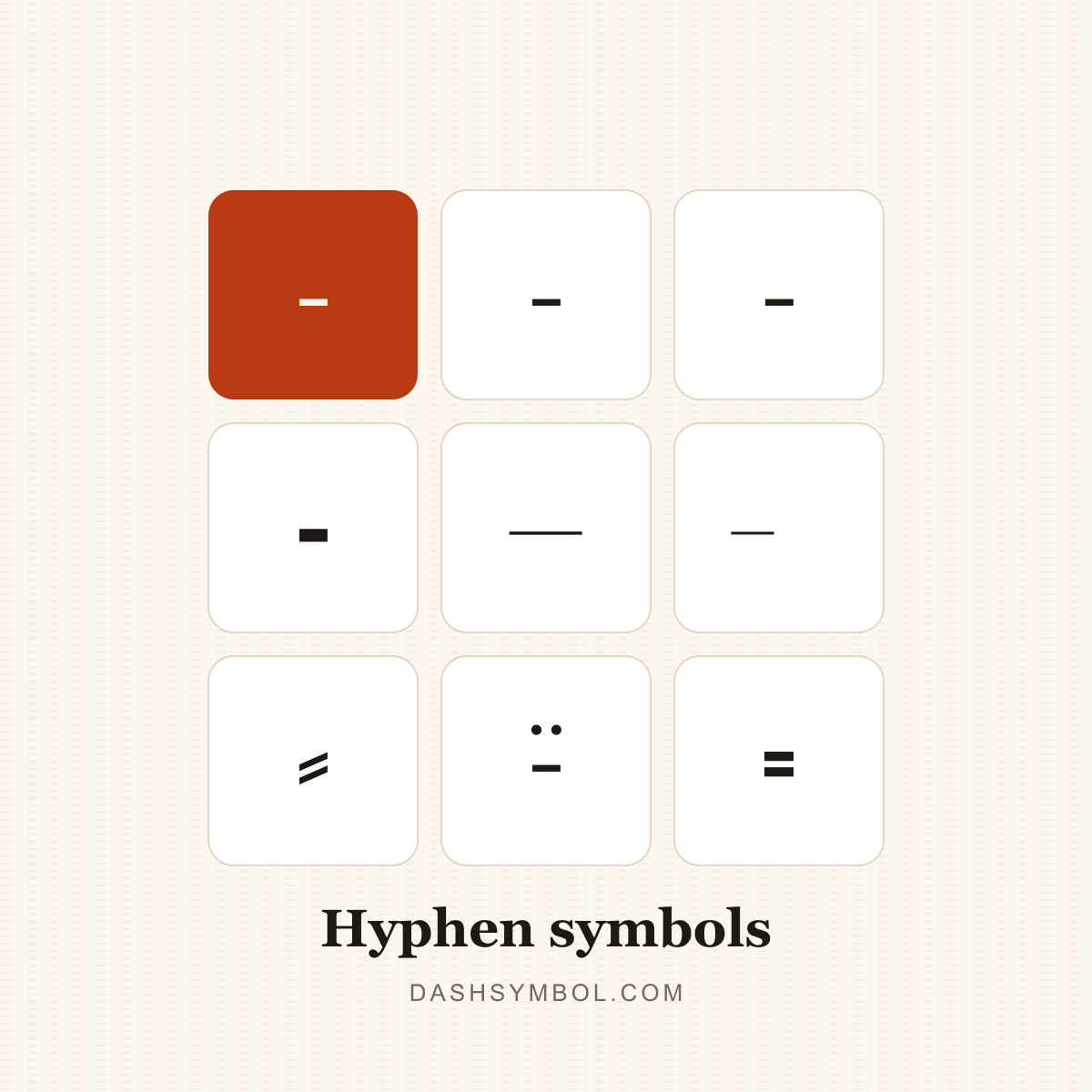
Click a tile to copy. Each symbol’s name links to its full codes and typing page in the table below.
Codes for hyphen symbols
Every symbol in this category with its Unicode code point and a recommended HTML value. Click the glyph or any chip to copy it.
| Symbol | Name | Unicode | HTML |
|---|---|---|---|
| Hyphen-MinusBasic Latin | |||
| HyphenGeneral Punctuation | |||
| Non-Breaking HyphenGeneral Punctuation | |||
| Hyphen BulletGeneral Punctuation | |||
| Double Oblique HyphenSupplemental Punctuation | |||
| Hyphen with DiaeresisSupplemental Punctuation | |||
| Double HyphenSupplemental Punctuation | |||
| Oblique HyphenSupplemental Punctuation | |||
| Dash with Left UpturnSupplemental Punctuation | |||
| Fullwidth Hyphen-MinusHalfwidth and Fullwidth Forms | |||
| Small Hyphen-MinusSmall Form Variants |
HTML values are named entities where a common one exists, otherwise decimal numeric references that work in any HTML document.
Using hyphen symbols
Hyphens are not dashes. A hyphen joins — a well-known author, a five-year plan, re-enter — while a dash separates phrases, ranges or clauses and is usually longer: the en dash – or the em dash —. Style guides disagree about which compounds need a hyphen, but the character always has the same job: it binds rather than separates.
One hyphen-like character is invisible in normal use: the soft hyphen marks a possible line break and is drawn only if the line actually breaks. It is not included in the grid below because it has no visible glyph. The non-breaking hyphen looks like an ordinary hyphen but forbids a break at that point. The specialist forms in this category — double oblique hyphen, double hyphen, oblique hyphen and dash with left upturn — are rare marks rather than everyday punctuation.
- Click a tile to copy the symbol; the “Copied!” badge confirms it is on your clipboard.
- Open a symbol’s page for its Unicode name, HTML entity, CSS and JavaScript escapes, UTF-8 bytes and keyboard routes.
- Use the dash converter when you need to replace hyphens across a whole text.
- Use the dash line generator when you want a divider or a repeated line at an exact length.
Need the wider picture? Read the hyphen vs dash guide, the em dash vs en dash guide, or how to type a dash. For sentence-level patterns, see the em dash examples.
Related dash categories
Hyphens questions
What is the standard hyphen symbol?
The standard keyboard hyphen is - (U+002D HYPHEN-MINUS). Unicode also has a dedicated typographic hyphen, ‐ (U+2010 HYPHEN). Most people and most software use the hyphen-minus, but the dedicated hyphen is the more precise choice in typeset text.
What is the difference between a hyphen and a dash?
A hyphen joins parts of a word or phrase, as in well-known or five-year plan. A dash separates phrases or clauses and is longer: the en dash – is used for ranges and connections, and the em dash — for asides and interruptions. They have different code points and jobs.
When should I use a non-breaking hyphen?
Use ‑ (U+2011) in phone numbers, product codes and hyphenated names that must not split across lines. It looks like a hyphen but forbids a line break after it. It is different from the soft hyphen, which is invisible unless a break occurs.
Why are there fullwidth and small hyphens?
CJK typesetting uses fullwidth characters that occupy one em, so Unicode includes a fullwidth hyphen-minus (-) and a small form (﹣) for compatibility text. They are not normally produced by a Latin keyboard and are not interchangeable with the ASCII hyphen in code.